TOGAF 9 Foundation Exam Preparation
An architecture framework is a set of tools which can be used for developing a broad range of different architectures.
It must:
It must:
- have a list of compliant products that can be used to implement the building blocks
- provide a common vocabulary or language
- have a set of tools
- have a method for defining an information system in terms of a set of building blocks
TOGAF is one of such an architecture frameworks available in the market. The Open Group Architecture Framework (TOGAF) is a framework for enterprise architecture which provides an approach for designing, planning, implementing, and governing an enterprise information technology architecture. TOGAF is a high level approach to design. It is typically modeled at four levels: Business, Application, Data, and Technology. It depends heavily on modularization, standardization, and already existing, proven technologies and products.
Still TOGAF has its own view, which may be specified as either a "formal description of a system, or a detailed plan of the system at component level to guide its implementation", or as "the structure of components, their interrelationships, and the principles and guidelines governing their design and evolution over time."
The Architecture Development Method (ADM) is core of TOGAF which describes a method for developing and managing the lifecycle of enterprise architecture.
TOGAF was initiated in the early 1990s as methodology for the development of technical architecture, and has been developed by The Open Group into an extensive enterprise architecture framework.
The latest version is TOGAF 9.1, launched on 1 December 2011. TOGAF 9 includes many new features like:
- Elimination of unnecessary differences
- Increased rigor, including a formal Content Metamodel that links the artifacts of TOGAF together
- Many more examples and templates
Additional guidelines and techniques like:
- Business capability-based planning
- A formal business-driven approach to architecture
- Guidance on how to use TOGAF to develop a Security Architecture or SOA
Main TOGAF Topics
Enterprise architecture domains:
a) Business Architecture - defines business strategy, governance, organization, and key business processes of the organization
b) Application Architecture - provides a blueprint for the individual application systems to be deployed, the interactions between the application systems, and their relationships to the core business processes of the organization with the frameworks for services to be exposed as business functions for integration
c) Data Architecture - which describes the structure of an organization's logical and physical data assets and the associated data management resources
d) Data Architecture - which describes the hardware, software, and network infrastructure needed to support the deployment of core, mission-critical applications
e) Technology Architecture
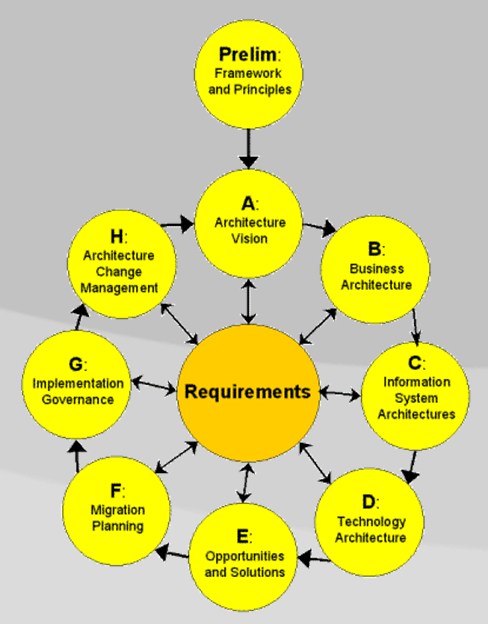
Architecture Development Method:The Architecture Development Method (ADM) is applied to develop an enterprise architecture which will meet the business and information technology needs of an organization. It may be tailored to the organization's needs and is then employed to manage the execution of architecture planning activities. The process is iterative and cyclic. Each step checks with Requirements.
Enterprise Continuum: The Enterprise Continuum is a way of classifying solutions and architectures on a continuum that ranges from generic foundation architectures through to tailored organization-specific both within and outside the Architecture Repository. These include architectural models, architectural patterns, architecture descriptions, and other artifacts.
The Enterprise Continuum consists of both the Architecture Continuum and the Solutions Continuum. The Architecture Continuum specifies the structuring of reusable architecture assets and includes rules, representations, and relationships of the information system(s) available to the enterprise. The Solutions Continuum describes the implementation of the Architecture Continuum by defining reusable solutions building blocks.
The Open Group oversees formal qualifications in TOGAF at two levels, which can be taken following formal training or self-study.
Foundation: (Level I) Ensures that an individual understands Enterprise Architecture along with core concepts and terminology of TOGAF.
Certified: (Level II) Further to the Foundation qualification, this establishes that the candidate is able to analyse and apply their knowledge.
I have cleared the foundation exam with 87% on 12/13/2014 and now preparing for the certification exam.
Major tips for the foundation exam are:
1. I did register myself in the site http://www.opengroup.org/togaf/ to start preparing the exam
2. The 'Student Study Guide' (from Open Group) provided was helpful, we needn't have to go through the entire book.
3. Do not spend too much time (for the Foundation Exam) on Artifacts for each phases. But they are important during the Certification exam.
4. Be comfortable with 'Objectives' of each phase/technique.
5. Be comfortable with Input/Outputs
6. The grey area is always between 'Prelim & Phase A' or 'Phase E & Phase F', make sure you are clearly able to distinguish them.
7. 'Key Terms' are important to memorize the definitions.
8. If you are comfortable, by 20-25 mins time, one should be able to attend (first pass) all the questions (mark it for review, if not answerable). Then the 2nd/3rd pass to review the 'Marked' questions can happen.
Sample exams are available in the below listed URLs were quite helpful for me.
References:
1)
Google.com
2)
Opengroup.org
3)
Wikipedia.org
TOGAF 9 License# 91516


